The 12 Permaculture Principles Applied to Investing
How Natural Intelligence Guides Our Investment Process
Below are the 12 permaculture principles developed by David Holmgren and Bill Mollison, and how we apply each one to business development and investing at Pythia Capital.
| Principle | Application in Business and Investing |
|---|---|
| 1. Observe and Interact | Detailed observation of where we are, relying on primary observation and accredited sources, not second-hand information. |
| 2. Catch and Store Energy | Manage risks carefully, storing excess reserves, not building beyond what resources can support. |
| 3. Obtain a Yield | Maximize profit that is productive, fair and sustainable. |
| 4. Self-Regulate, Accept Feedback | Actively incorporate feedback and look for negative results. |
| 5. Use and Value Renewables | Focus on goodwill and trust; business inputs sustainably managed; look to nature for answers (do not replace it). |
| 6. Produce No Waste | Waste reflects poor design; output from one system could be input to another. |
| 7. Design from Pattern to Detail | Step back and see from a bigger picture; holistic perspective of how things are interconnected. |
| 8. Integrate | Maximize beneficial relationships for a more integrated solution vs. increased specialization and compartmentalism. |
| 9. Use Small, Slow Solutions | Big is not always better; new opportunities are not always visible or easy to exploit from a macro level. |
| 10. Use and Value Diversity | Monocultures are fragile and prone to disease; a more vital and resilient community results from a diversity of cultures, small business, local food and energy supplies vs. more centralized systems and globalization. We need to consciously plan our businesses and investments to find better balance. |
| 11. Use Edges; Value the Marginal | Innovation rarely comes from the center; it comes from the fringe thinkers, which are often excluded and marginalized in typical, elite business, scientific, and investment circles. |
| 12. Creatively Use and Respond to Change | Natural systems are not static; always observe and look for new opportunities and new ways to manage risk. |
Why These Principles Work
These principles aren’t arbitrary rules or trendy frameworks. They’re based on billions of years of evolution - nature’s tested and proven methods for creating resilient, adaptive, sustainable systems.
When we apply them to investing:
- We see opportunities others miss (because we’re looking at different patterns)
- We manage risk better (because we understand system dynamics)
- We identify innovation earlier (because we value the edges)
- We create aligned incentives (because we design for integration, not extraction)
Nature doesn’t do quarterly earnings. Nature does sustainability, resilience, and emergent value creation. That’s what we track.
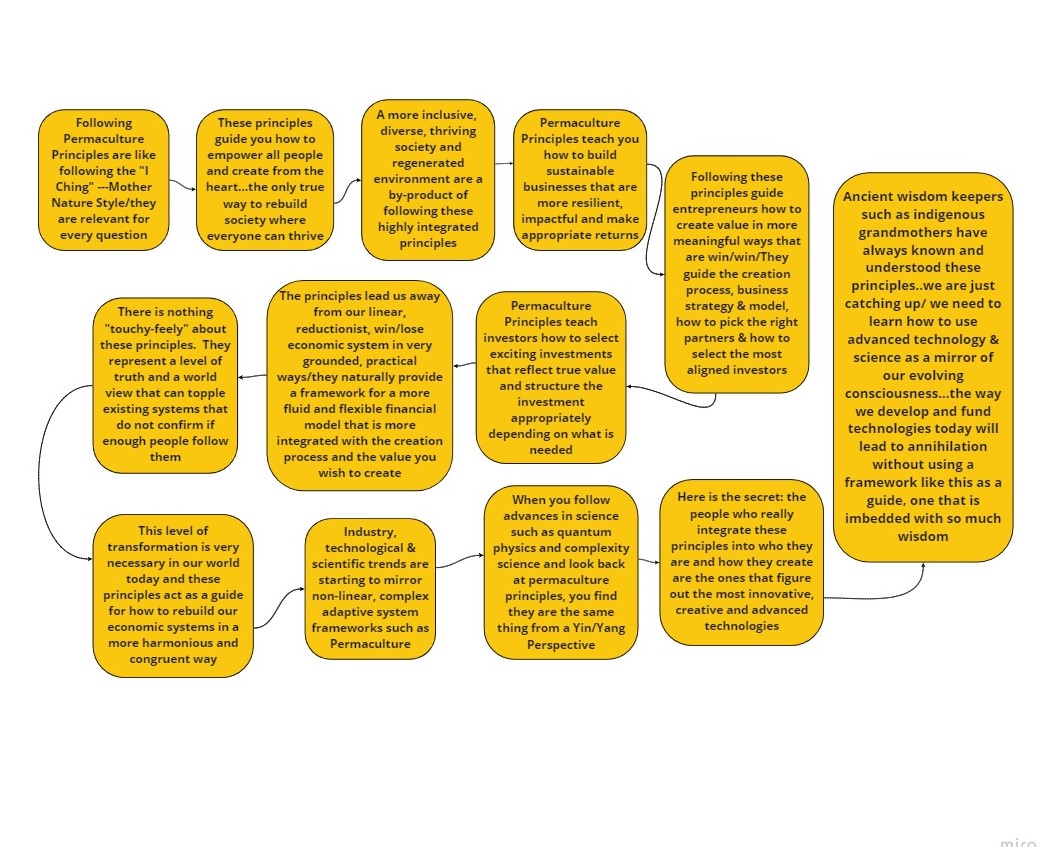
Permaculture principles act as a bridge between ancient wisdom and modern science, creating a framework for coherent decision-making in complex systems.
Going Deeper
Each of these principles contains layers of wisdom that become clearer as you work with them. They’re not a checklist - they’re a lens for seeing the world differently.
In The Pythia Scrolls, we show how these principles reveal patterns in specific companies, industries, and market dynamics that conventional analysis misses.
Want to learn more? Download our free book: Permaculture and Investing: 12 Principles for Regenerative Capital
Back to Living Systems Investing